
Name-Based Case Searches
The state's name-search tool is the Nebraska JUSTICE One-Time Case Search. It hangs everything on a party name. It serves people who are parties to a case. Witnesses need something else. Enter a complete name first. Only add filters when a common name floods the screen with possible matches. Before trusting any result, line up the court, county, case type, year, and party role against what you know. A public result proves nothing about identity and is not a certified court record.
After agreeing to the terms, the paid one-time workflow opens. Its documentation lists search paths by party name, case number, and judgment date. It also offers filters for court type, case type or subtype, county, year, judge, attorney, and party. Pick Dodge County and the right court when you truly know them. A guessed filter can bury the very record you want, so leave it out.
- Decide whether the matter belongs in Dodge County Court or Dodge District Court.
- Enter the complete party name into the official JUSTICE route and follow the required terms step.
- Add Dodge County, court, case type, year, or another reliable filter only if the result set needs narrowing.
- Compare the returned record’s court, party role, case type, and time period before opening Case Detail.
- Read the Register of Actions and use the clerk or calendar to confirm a pending event.
The JUSTICE terms workflow presents the acknowledgment a user must accept before the paid party-name search goes forward.
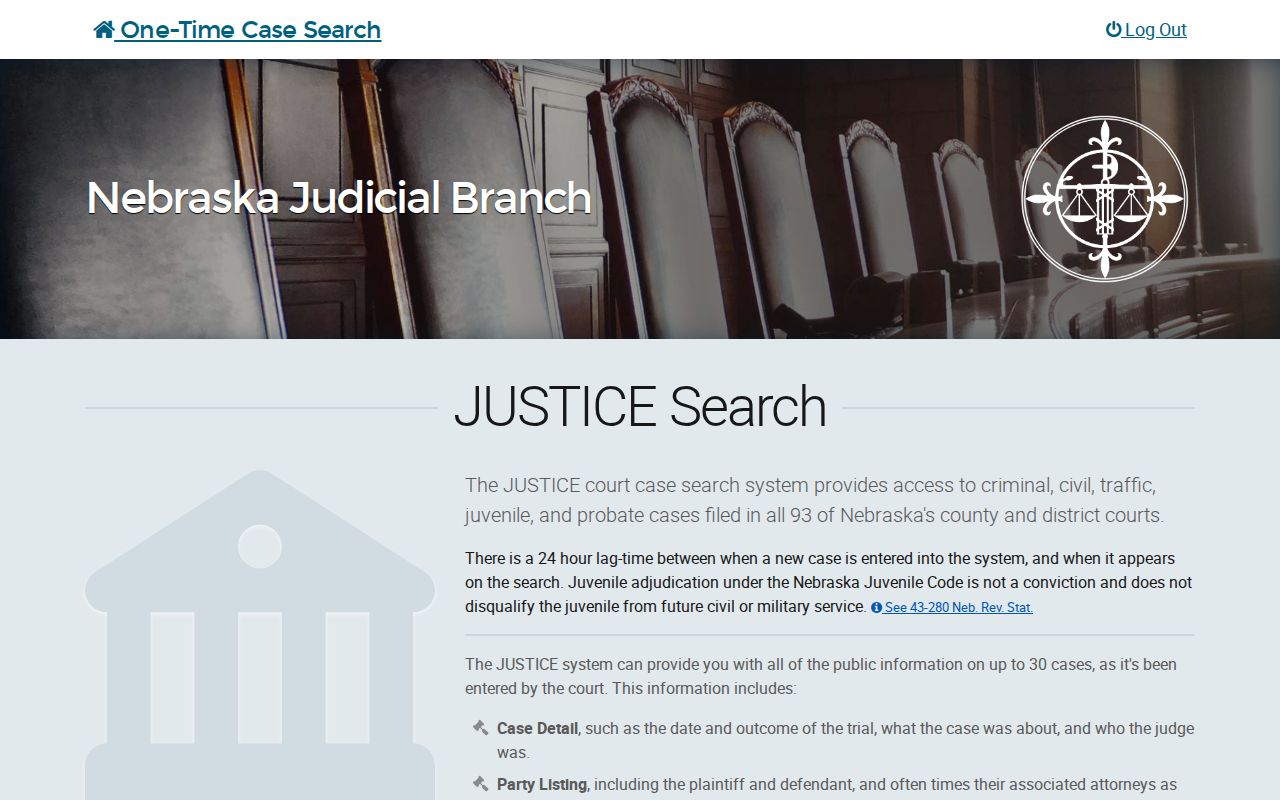
The search screen is simply the entry point to the official service. It says nothing about any private case. The available criteria can be described generally, though not every field shows up on every screen.
| Search criterion | Type | Required | Use in a Dodge search |
|---|---|---|---|
| Party name | Text | Central one-time search input | Use the complete name and compare returned party roles. |
| Case number | Exact identifier | No | Use when it comes from a court notice or already-known official source. |
| County and court | Selection filters | No | Narrow to Dodge County Court or Dodge District Court when known. |
| Year, type, judge, attorney | Available narrowing filters | No | Apply reliable facts only after a broad result needs refinement. |
Dodge County Case Search Courts
Which court holds the record? That is the first local decision in a Dodge County case search. County Court handles misdemeanors, traffic, municipal ordinance violations, and preliminary felony hearings. It also takes civil matters within its jurisdiction, small claims, probate, guardianship, conservatorship, adoption, condemnation, and most juvenile matters. Dodge District Court is the general-jurisdiction court. It hears district felony trials, broader civil and domestic-relations cases, and appeals from County Court. A felony or an appeal can leave records in both courts at different stages, so check each.
Ordinance complaints from Fremont, Hooper, North Bend, and Scribner start in County Court. No city runs its own separate municipal court docket. The County Court contact directory shows the route to the Dodge County Court clerk.
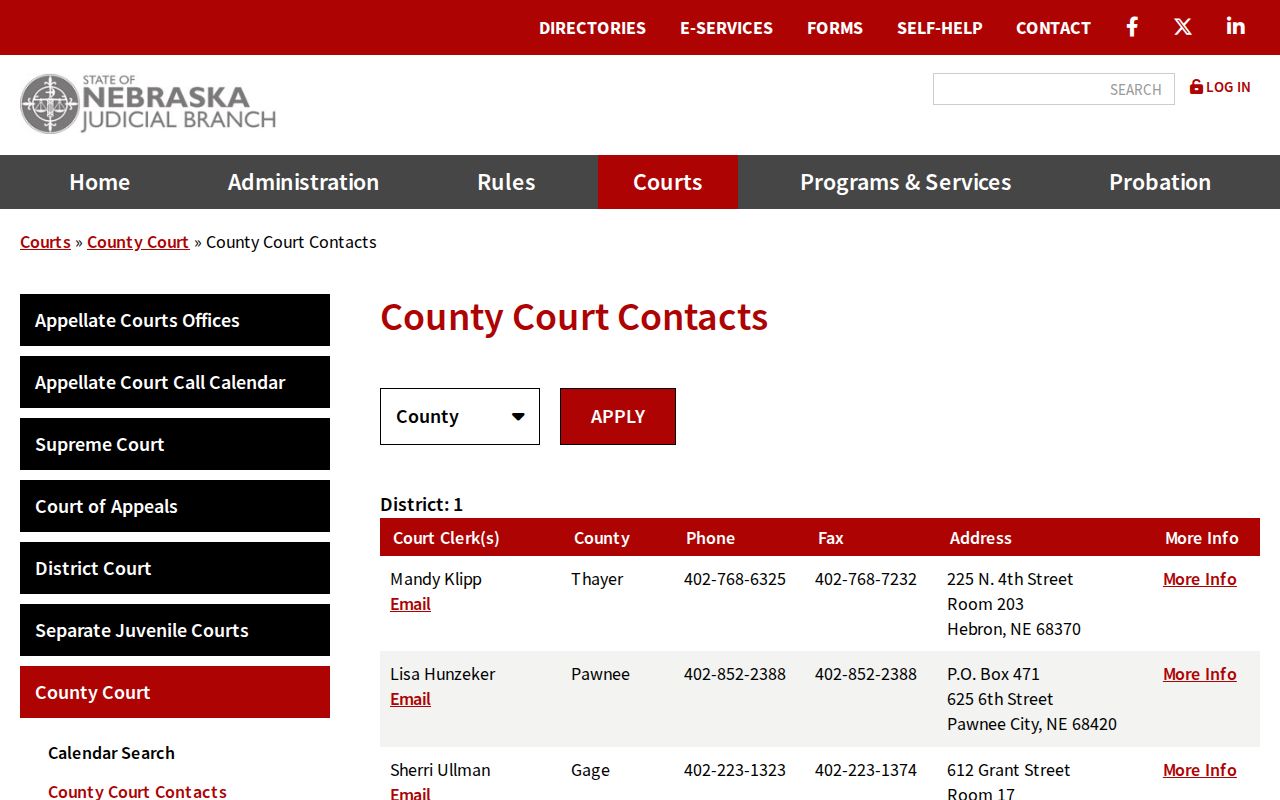
Marissa Miller serves as the Dodge County Court clerk, a role separate from the county-government clerk office. For district-level records, the District Court clerk directory points the way.
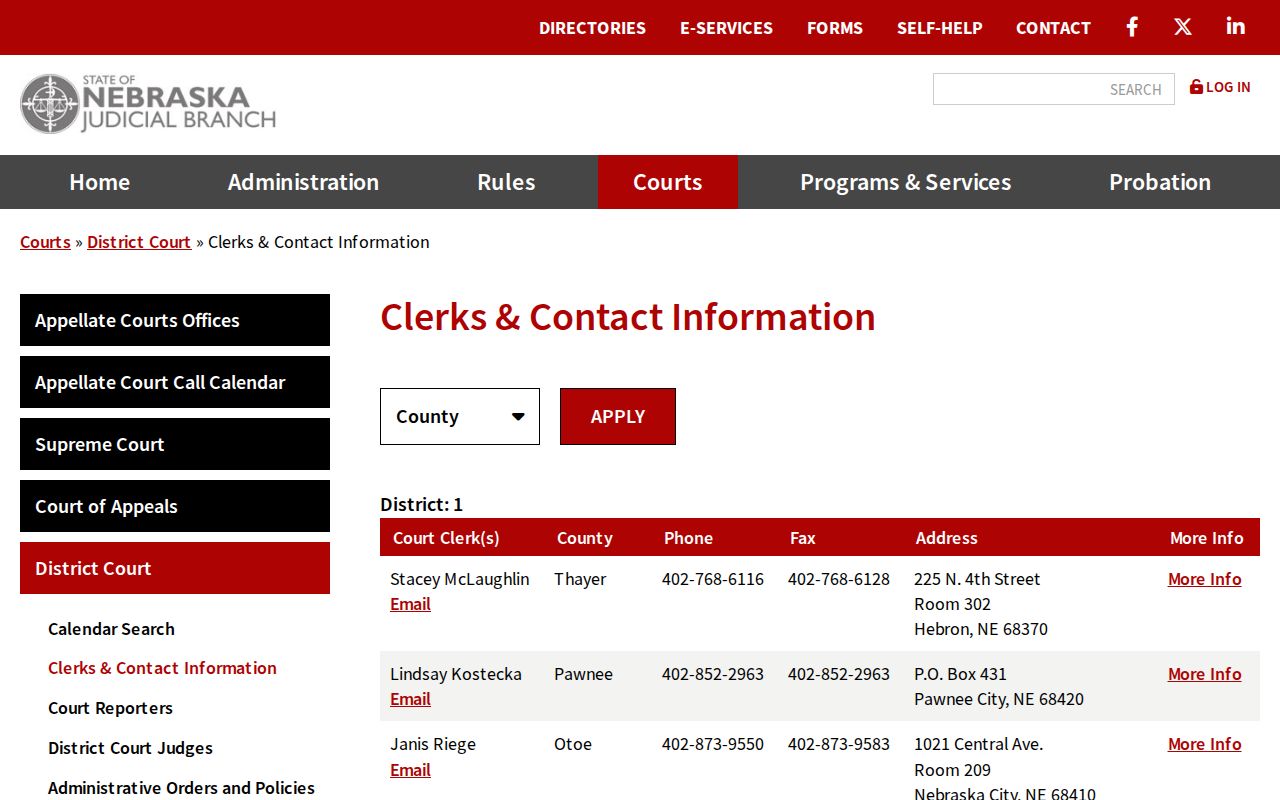
Judith Wegner is the Dodge District Court clerk and the right contact for district-level records.
Case Number Searches
For a Dodge County case search, nothing beats an exact case number. Copy every character exactly as it appears on a court notice, citation, or clerk letter. Nebraska's public materials describe a case-number search path. But they publish no Dodge-specific format, prefix legend, or sample number. Treat the number as an opaque identifier. Do not try to crack it.
Never build a number from a year, a guessed case type, or a short docket abbreviation. The court publishes no Dodge disposition-code legend either. When a status or procedural term in a public result stays murky, use the label exactly as displayed. Then ask the clerk. That keeps a guessed prefix from becoming a false claim. It protects you from misstating the court, the charge, or the outcome.
Dodge County Case Number Priority
Got a common name? Reach for the case number before stacking up shaky filters. It narrows the Dodge County docket search. There is no guessing at the court, the date, the case type, or the spelling. With only a name in hand, hold onto the details that separate matches. Those include the county, the court, the approximate year, the party role, the attorney, and the case category. A traffic citation may also carry a citation number, offense date or time, and an issuing agency. It can show an IR or case number if listed, plus the court date.
When an exact number returns nothing, check your court selection and transcription first. A 24-hour entry lag, a restricted category, an older record, or a retention issue could also explain it. The clerk can handle a specific public record request. Statewide policy does not require staff to certify that a broad search found no record.
Dodge County JUSTICE Search Limits
The one-time JUSTICE search costs $17, effective January 1, 2026, even when nothing comes back. It allows viewing of up to 30 cases for three calendar days. Entries can lag by a possible 24 hours. Those caps matter with a common party name or a fresh filing. A no-result search may reflect scope, timing, court selection, or an access limit. It does not prove the absence of a court record. The one-time search terms and conditions belong to the paid workflow.
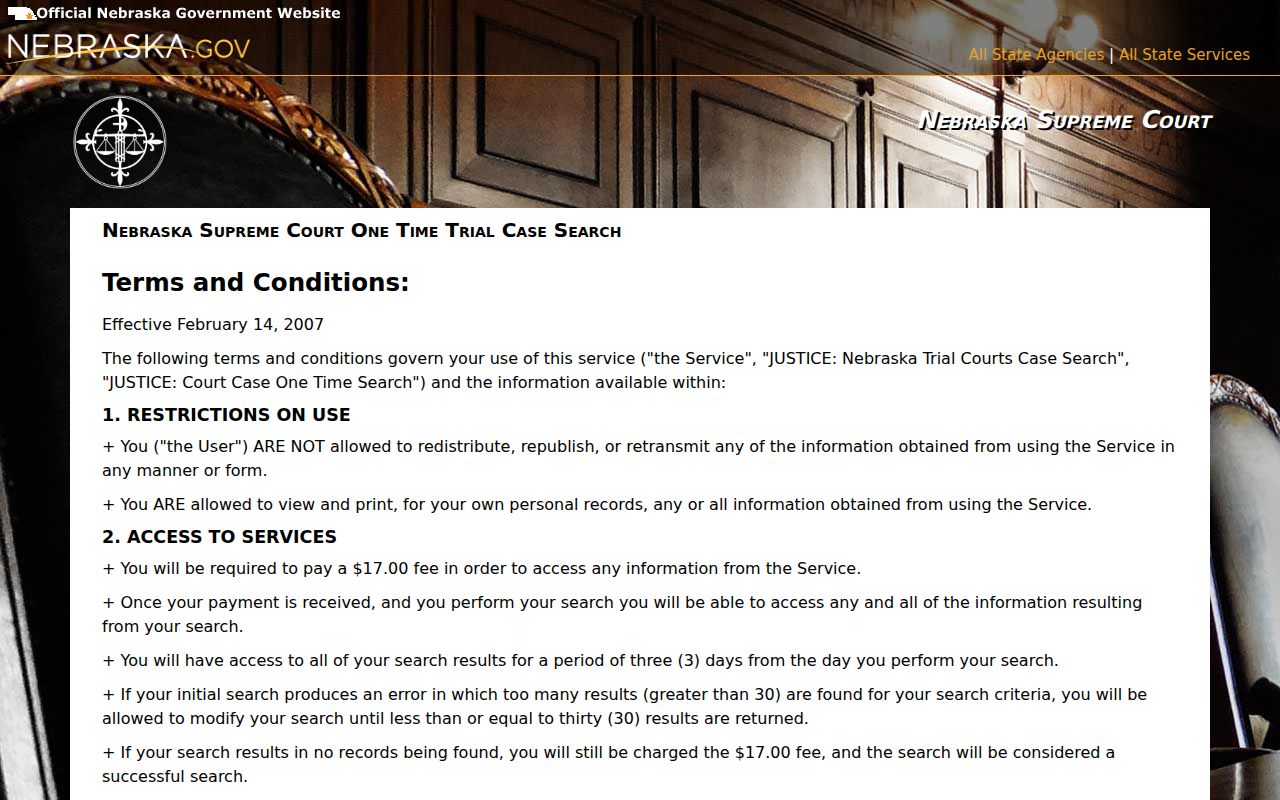
Reading those terms ahead of time sets fair expectations about the cost, the result cap, and the limited viewing window.
Case Search Results Explained
A JUSTICE result opens into several layers. Case Detail gives the summary. Party and offense information appear for criminal cases, along with financial details. The Register of Actions is the timeline, and judge notes or document images show up where they exist. Read entries in date order, because a later entry can change what an earlier setting means in practice. A single status label will not capture that.
Document images are not the same thing as the event list. Nebraska provides images of filed or uploaded documents after April 16, 2008 when they are public and available. That date is no promise. Not every entry gets an image. A short event label also cannot show you the full text of the filing or order behind it.
| Case Detail | The high-level summary of court, case type, judge, parties, and available outcome information. |
|---|---|
| Party listing | Parties, roles, and attorneys where entered in the public record. |
| Register of Actions | The chronological list of filings, hearings, notices, orders, judgments, payments, and other activity. |
| Financial information | Available assessments, payments, balances, or judgment-related information; it does not replace the order. |
| Images | Public, available electronic document copies linked from the record when present. |
The Judicial Branch’s case-information e-services page describes these statewide case-detail categories.
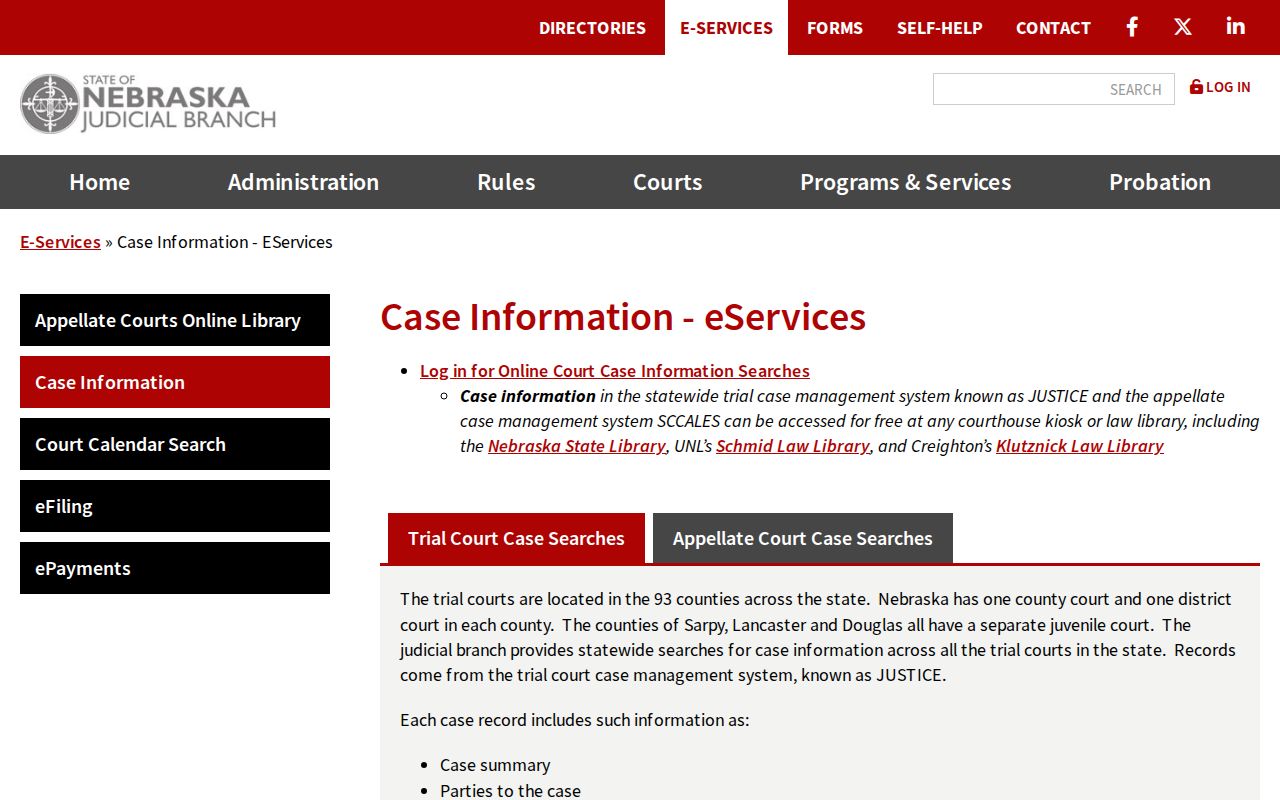
This is a field guide to reading public case results. It does not display a private Dodge case.
Dodge County Docket Register Timeline
Nebraska calls the court's chronological event list the Register of Actions. In a civil matter, it can run from complaint or petition through service, appearances, motions, hearings, and orders. Later entries may add judgment, satisfaction, or appeal. In a criminal matter, it can show a charge, plea, preliminary hearing, motion, and setting. It may also list trial, disposition, sentence, payment, warrant, or appeal. The event names record what was entered. They do not capture every reason behind a court's action. Read them as a timeline, not a full story.
- Setting
- A scheduled court event. The public calendar may show it, but a later docket entry or clerk confirmation can alter it.
- Continuance
- A postponement of a hearing, trial, or other event.
- Reset
- A new setting after an earlier date moves or is replaced; the original date can remain visible in the chronology.
- Disposition
- The recorded result or resolution. Its exact meaning depends on the record and case type.
Dodge County Subscriber Detail Search
Frequent users can skip the one-time route with the Nebraska.gov Subscriber JUSTICE service. It supports recurring statewide trial-court access. Search routes include name, case number, and judgment date. Filters cover county, year, case type, court type, judge, attorney, and party. Current trial-court record details cost $2 per selected detail. The state describes images as included with that detail when available.
Do not confuse subscriber access with attorney eFiling. The public case-information index and the filing system do different jobs. A subscriber account suits recurring research. The public-access rules on each case record still govern what a result or image reveals.
The official Subscriber page describes recurring search, index products, and related court services.
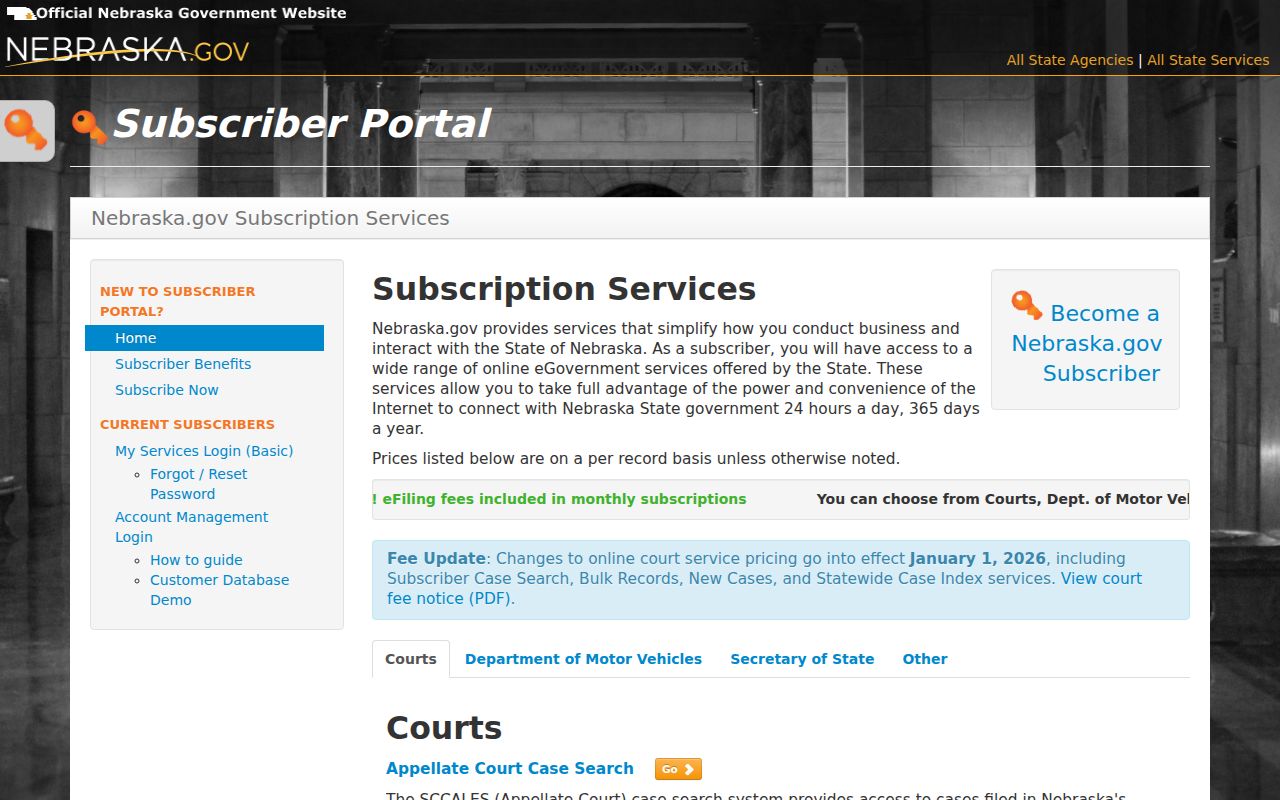
Subscriber access is statewide, not a Dodge County database. It is a recurring access layer over the same courts, not a separate Dodge County court docket system.
Two Ways to Search: County and State
Dodge County runs no separate online case-search portal of its own. Instead, the state fills that role. JUSTICE is Nebraska's statewide system. It covers both Dodge County Court and District Court dockets. For the local layer, go straight to the court clerk. Or use the public terminal at the courthouse. A sensible workflow: search JUSTICE first to locate the case. Then lean on the Dodge County clerk or the terminal when a court record is old, missing its image, restricted, or when you need a certified copy.
| Statewide JUSTICE | Dodge court clerk or terminal |
|---|---|
| Searches participating county and district trial-court records statewide. | Addresses the known Dodge court record and local public-terminal access. |
| Provides case detail, Register of Actions, financial information, and available images. | Can address specific public copies, certification, retention, and access questions. |
| One-time search is $17; Subscriber details are currently $2. | Copy and certification charges apply where the record and request allow them. |
Neither channel replaces the other. Picking the right court and the right record request beats running the same name through a docket search again and again.
Dodge County Calendar Search Scope
The Nebraska court calendar service answers one question well: when is a hearing set? It handles current and future settings, not a full case history. You can choose County Court or District Court. You can also search by date or last name. Two cautions apply. The service itself warns that results may lag. A blank result does not mean no court date exists. An empty calendar is not a ruling on anything.
A calendar and a Register of Actions serve different purposes. Check the calendar for scheduling. Read the docket for filings, orders, payments, and the full chronology of the court record. If a setting looks doubtful, call the court office that holds the case and confirm.
Dodge County Docket eFiling Boundary
Nebraska Judicial Branch Trial Court eFiling plugs into JUSTICE. It is built for lawyers, not for the public. Filing, service, and notices flow through it, and using it requires attorney status plus a Nebraska.gov Subscriber account. Public JUSTICE search is something else entirely. It is a case-information index for anyone, not an eFiling login and not a free document viewer. Even a document filed through eFiling can be redacted, confidential, sealed, or missing its image.
The Trial Court eFiling information spells out its eService and eNotice role. For an ordinary Dodge County docket question, stick with JUSTICE, the courthouse terminal, or the clerk. Treat eFiling as a filing tool. Never treat it as a public docket search.
Which Cases Stay Restricted
Not every file is open. Neb. Ct. R. §1-808 lists what the public cannot see. That covers records closed by law, rule, or case law, criminal-history limits, adoption files, and sealed material. Rule §2-210 covers protected information, redaction, and confidential cover sheets. It also explains how a specific document gets sealed. Sealing always takes a court order. Nobody can hide a filing on their own.
Juvenile files get extra protection under Neb. Rev. Stat. §43-2,108. Dodge County Court hears most local juvenile matters. That placement does not turn a juvenile case into an ordinary public record. So a thin result in a Dodge County docket search can mean a sealed record, juvenile confidentiality, adoption protection, or redaction. It does not mean nothing happened in court.
Dodge County Missing Docket Paths
A Dodge County docket search that comes up empty usually points to one of three things. The case may sit in the wrong court. The record may be restricted or not yet indexed. Or there may be a retention and image problem. First, confirm the court. Some matters belong in County Court. Others belong in District Court. Next, remember that new filings take time to appear in the index. Allow for the stated entry lag. If you know the case is public, go straight to the courthouse JUSTICE terminal. Or call the right clerk. County Court's criminal and traffic division answers at 402-727-2758. Its main line is 402-727-2779, and District Court clerk Judith Wegner's office is 402-727-2780.
Both courts sit in the Judicial Center at 428 N Broad St in Fremont. When you ask, request the particular public record rather than a general no-record certificate. Statewide policy lets staff search a specific record when you give a complete party name plus the case year or case type. They can provide copies once the case number identifies the record. Staff will not, however, sign any certificate saying a search found no record. That distinction matters. A protected record, an unavailable image, or a destroyed record each follows a different response path. That differs from a search term that just needs fixing.